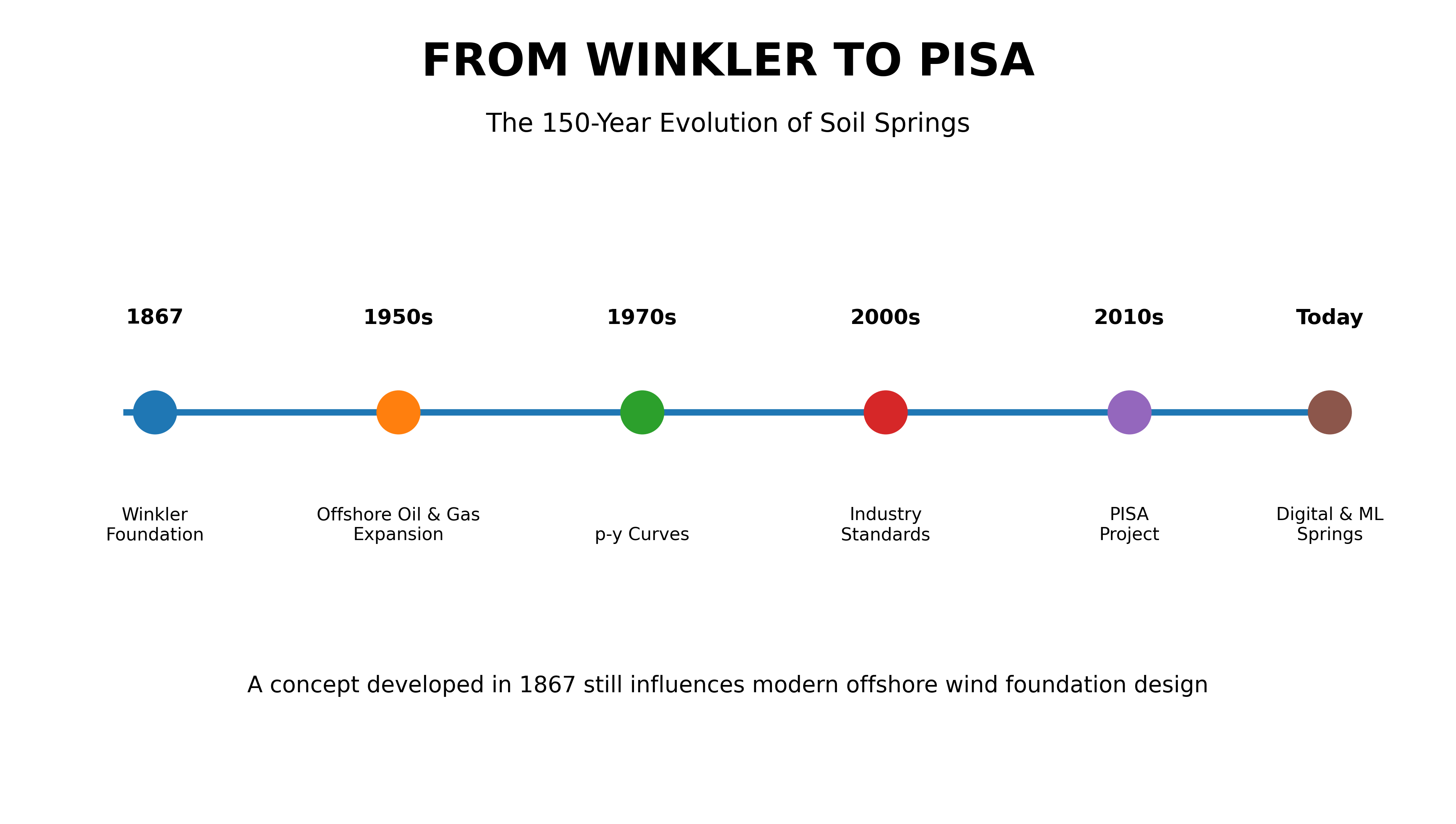
When designing offshore foundations today, whether using traditional p-y curves or modern PISA-based approaches, we rarely stop to ask a simple question:
𝐖𝐡𝐞𝐫𝐞 𝐝𝐢𝐝 𝐬𝐨𝐢𝐥 𝐬𝐩𝐫𝐢𝐧𝐠𝐬 𝐚𝐜𝐭𝐮𝐚𝐥𝐥𝐲 𝐜𝐨𝐦𝐞 𝐟𝐫𝐨𝐦?
The answer takes us back more than 150 years, long before offshore wind, offshore oil and gas, or even modern geotechnical engineering existed.
In 1867, the German engineer Emil Winkler introduced a remarkably simple concept for representing the interaction between a structure and the supporting ground. Instead of treating the soil as a complicated continuous material, he represented the support provided by the ground as a series of independent elastic reactions acting beneath a structure ➊.
The idea was straightforward:
The greater the displacement, the greater the reaction from the soil.
Today this is known as the Winkler foundation model, and despite its simplicity, it became one of the most influential concepts in soil-structure interaction.
At first glance, the assumption appears heavily simplified. Real soil is not a collection of independent springs. A displacement at one location influences stresses and strains around it. Soil behaves nonlinearly, can fail, soften, stiffen and generate excess pore pressures.
The Winkler model captures none of this, and yet it survived.
𝐖𝐡𝐲 𝐬𝐨𝐢𝐥 𝐬𝐩𝐫𝐢𝐧𝐠𝐬?
Because engineers needed a practical solution.
Before numerical modelling and finite elements, solving full continuum soil problems was simply not feasible for most projects. The Winkler model allowed engineers to capture the essential interaction between a structure and the ground using relatively simple mathematics.
Its influence quickly spread into the analysis of railway tracks, pipelines, retaining structures and piles. More importantly, it established a philosophy that still underpins many of the methods we use today:
𝐂𝐨𝐦𝐩𝐥𝐞𝐱 𝐬𝐨𝐢𝐥 𝐛𝐞𝐡𝐚𝐯𝐢𝐨𝐮𝐫 𝐜𝐚𝐧 𝐨𝐟𝐭𝐞𝐧 𝐛𝐞 𝐫𝐞𝐩𝐫𝐞𝐬𝐞𝐧𝐭𝐞𝐝 𝐛𝐲 𝐚 𝐬𝐞𝐭 𝐨𝐟 𝐞𝐪𝐮𝐢𝐯𝐚𝐥𝐞𝐧𝐭 𝐬𝐩𝐫𝐢𝐧𝐠𝐬.
As noted by Kerr ➋, the simplicity of the Winkler model was both its greatest strength and weakness. More advanced continuum approaches followed, but engineers continued to rely on spring-based methods because they offered a practical balance between complexity and accuracy.
More than a century later, offshore engineers would adopt this same philosophy and transform it into the p-y, t-z and q-z curves that became industry standards for pile design.
Many engineers use these curves every day without realising that their origins can be traced back to a concept developed more than 150 years ago, long before offshore engineering existed.